The Omberg is situated in Östergötland on the shore of Lake Vättern. This mountain is Sweden's most species-rich forest landscape with many rare natural environments. The bold beech forest on the slope of Vättern, the giant oaks in the pasture landscape and the colourful mowing meadows are just three examples.
A mile-long steep bank characterizes the mountain to a large extent. Visitors can enjoy the fantastic view from Hjässan - Omberg's highest point -, walk among giant oaks and more than 100 years old fir trees or be enchanted by beautiful orchids in Omberg's limestone moors.
Nature and Geology
Both - Omberg's vegetation and its animal life - are as varied as its highly remarkable geological conditions.
The Omberg is a so-called eyrie and is surrounded by distortions on all its sides. The mountain itself consists
mainly of granite. In the southeastern part there is also some gneiss at the age of 1.8 billion years. On the
side of the mountain facing Vättern, above all slate and sandstone emerges, which was formed 850-600 million
years ago. North of Omberg's granite mass, near Borghamn, limestone is in an almost horizontal deposit.
Limestone has been mined there for a long time, and this is still the case today. The undisturbed bearings show
that the dislocations at Omberg must be younger than the Ordovician (before 485.4 - 443.4 million years between
Cambrian and Silurian).
History
The name Omberg is made up of the old Nordic "ama" (for fog, smoke) and mountain. Its meaning is thus
"mountain of fog" or mountain, surrounded by haze and fog.
The tract around Omberg has been inhabited for a long time, and the pile dwellings at Alvastra bear witness to this. Man has left many interesting traces here.
During the turbulent period of migration around 400-500 AD, three so-called "Hillfort castles" were built on the Omberg. The Hjässaborg in the south is the largest with a 450 m long and 1.5 m high wall. Borggården is the best preserved castle. It is located about 2 km north of the Hjässatorget. Drottning Ommas Borg is the smallest and is located on the northwestern tip of the Omberg.
In the 12th century the Ombergstrakt became a centre for the Sverker dynasty. At about the same time a nobleman from Östergötland, Sverker, was elected king of Sweden. During his reign, the monastery was founded by Alvastra. The monastery was abandoned after King Gustav Vasa had confiscated the properties of the church for the state. During the monastery's time, at least five farms were set up on the Omberg, including Stocklycke, Elvarum and Höje. In connection with the creation of the state enclosure Stocklycke became the seat of the animal keepers and Höje domicile of the inspector.
During the 17th and 18th centuries, the Omberg was one of Sweden's largest state enclosures, i. e. the king's private hunting grounds. These were difficult times for the local farmers. They were forced to maintain and guard the 15,6 kilometer long fence around the enclosure so that no wolf or lynx could enter the area. At the same time, there was great poverty and poaching was a great temptation. The punishments were harsh if one was caught: beating with the rod, imprisonment or punishment in a fortress of the crown. The enclosure was closed in 1805. The majority of the harts were transported to Stockholm's animal park - the Omberg became Kronopark.
In the spring of 1859 a state forestry school was established in Höje, and at the same time the use of the Omberg forest began. During the forestry school epoch, a number of exotic tree species were settled on the Omberg, such as silver fir and larch, in order to increase the students' knowledge about foreign tree species. The forestry school was closed in 1935. The traditional forestry on the Omberg continued until 2003, when the Ecopark was inaugurated.
Ecopark is a larger coherent forest landscape with valuable nature and great nature conservation ambitions. With its 1700 hectares of land, the Omberg is one of Sveaskog's smaller ecoparks, but at the same time one of the most visited. Every year around 150,000 people visit the legendary mountain with its bold nature and many cultural monuments.
Show map on full screen.
1. Ecopark Centre Omberg
The Ecopark Centre in Stocklycke is a good starting point for a visit to the Ecopark, nature walks, hiking
trails and guided nature and culture walks start here.
2. Stocklycke äng
Stocklycke äng is a meadow with fantastic flowers. Sunroses, common milkwort (swed. Jungfrulin) and primroses grow here.
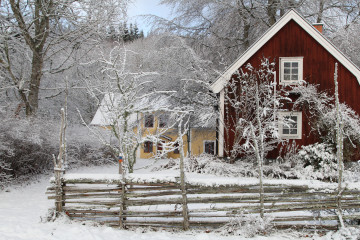 Stocklycke Youth Hostel and Café
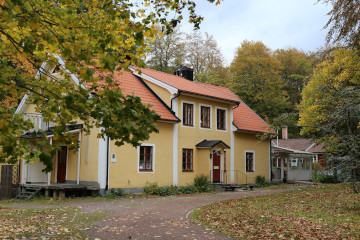 Stocklycke Youth Hostel and Café
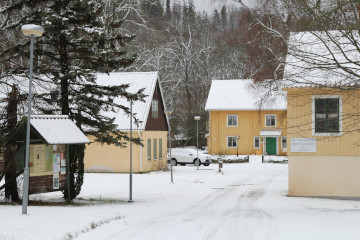
3. Stocklycke Youth Hostel and Café
At this place there was originally a farm, which belonged to the monastery in Alvastra. The youth hostel is
one of the oldest in Sweden and is located in the middle of the beech forest of Omberg, just a few hundred
metres from Lake Vättern. The hostel is Sweden's oldest and open all year round.
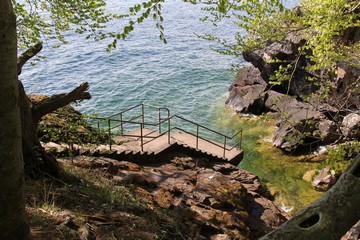 Staircase at Stocklycke Harbour
4. Stocklycke harbour
Until the 1950s, the port was of great importance for the economy of the Omberg region. Wood from forestry on
the mountain was shipped from here to the industries on Lake Vättern. In only a short distance south of the
harbour there is a visitor-friendly cave on the lake shore.
5. Rödgavels grotto
Rödgavel's grotto is the largest of fifteen caves on the steep bank of the Vättern. Water runs through the
ceiling into the lake. Legend has it that Queen Omma mourns her injured suitor. In cold winters, the tears of
Queen Omma freeze to long icicles in the cave. The ice formations take on the shape of the gnomes, trolls and
also the medieval monks who had sought shelter in the cave. Rödgavel's grotta extends twenty-one metres into
the mountain and has a ceiling height of 1.2 metres. She can only be reached by boat.
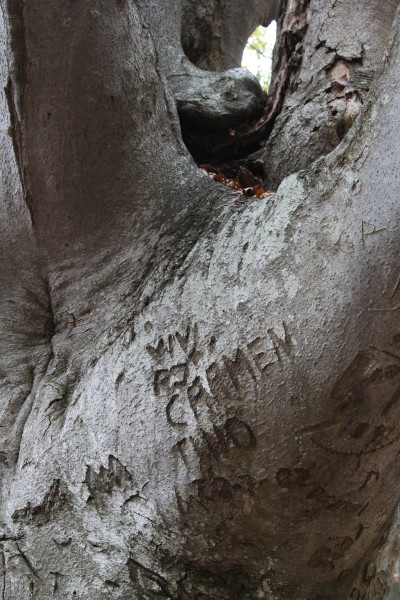 Beech forest nature reserve
6. Beech forest nature reserve
The Beech forest nature reserve is a beech and noble leaf forest on the slope to Lake Vättern. Here at the Omberg,
beech tree is found its northernmost habitat in eastern Scandinavia. The nature reserve is home to the oldest and
strongest specimens.
7. Västra Djurledet
In the first half of the 17th century, a state enclosure was built on the Omberg. It was surrounded by a
21-kilometre-long and about four-metre-high gärdesgård, which was maintained by the local farmers. Names such
as Södra and Västra Djurledet (southern and western animal path) and Brottsledet (stone quarry path) are remnants
of this period and refer to openings in the fence.
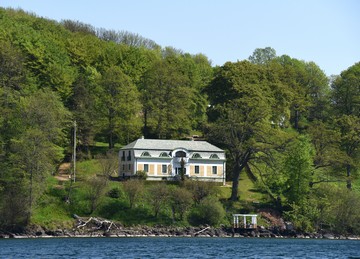
8. Ellen Keys villa Strand
Ellen Keys villa Strand is located in an inviting spot on Vättern, surrounded by beech forest. This is where
the writer Ellen Key (1849-1926) lived during her last period of life. The house was a meeting place for important
artists and writers of the time. Guided tours take place here from May to September.
Guided tours
for single visitors, max 20 persons/guided tour.
Pre-booking required.
For prebooked groups, special times apply.
1 May: 11 and 14.
3–11 May: Saturday-Sunday 11 and 14.
15 May–30 June: Tuesday-Sunday 11 and 14
1 July–14 August: Tuesday-Sunday 11, 12, 14 and 16.
15 August–31 August: Tuesday-Sunday 11 and 14.
1-30 September: Saturday-Sunday 11 and 14.
Prices for guided tour:
Adults 150 SEK
Youth 7-15 years 30 SEK
Children 0-6 years free
Heritagecard (Kulturarvskort) 75 SEK.
Contact
Alvastra, 599 93 Ödeshög
+46-144-330 30 (Telephone hours 1 may – 30 september:
Tuesday-Sunday 9-10)
Ellen Keys Strand
9. Sverkersgården
The Sverkersgården is a medieval remnant from the time of King Sverker and the powerful Sverker dynasty that
ruled Sweden in the 12th century. Here at this place were the remains of a crypt church. However, the square
was used long before Sverker's time.
10. Sverkerkapellet
The Sverker Chapel was uncovered during excavations in 1917-1919. At the time, it was thought to be the burial
chapel of the Sverker royal family. However, finds from modern times suggest that the building was an economic
facility (grangie) of the nearby Cistercian monastery in Alvastra, which must also be seen in connection with
the monastic facilities in the Ålebäcken valley.
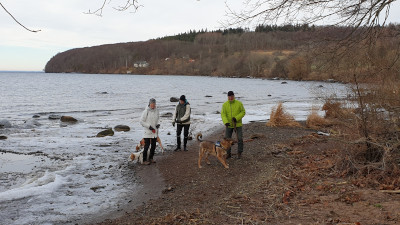 Hundpromenad vid Ålebäckens mynning
11. Ålebäcken / Alvastra kvarn
The Ålebäcken is one of the two outflows of the Tåkern. The monks had built a dam, a horizontal water mill and a
brickworks here in the valley near where it flows into Vättern. There was also a pier for shipping directly at
the outlet into the Vättern. Is this where the limestone that was quarried in Borghamn and from which the
monastery was built was landed?
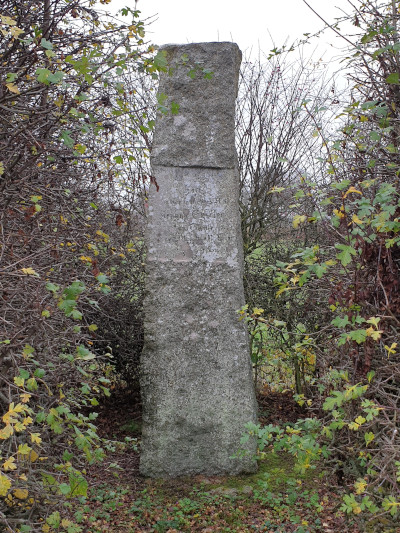 Sverkerstenen
12. Sverkerstenen
In the 12th century, Alvastra was associated with the history of the Sverker's dynasty.
This was the ancestral home of the royal family, and it was here that Sverker the Elder fell at the hands of a
murderer (probably his horse boy, instigated by the Danish heir to the throne) in 1156 on his way to the Christmas
service in the church of Västra Tollstad. He was subsequently buried in Alvastra Monastery.
The stone commemorates this.
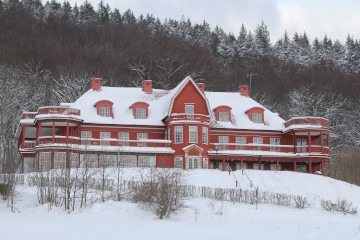 Ombergs Turisthotell
 Ombergs Turisthotell
 Ombergs Turisthotell ca. 1900. Photo: Lars Fredrik Lovén / Östergötlands Museum.
Ombergs Turisthotell
Ombergs Turisthotell
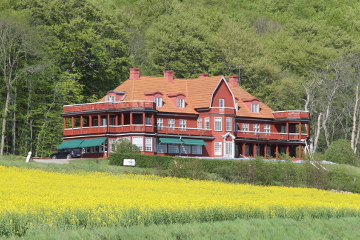
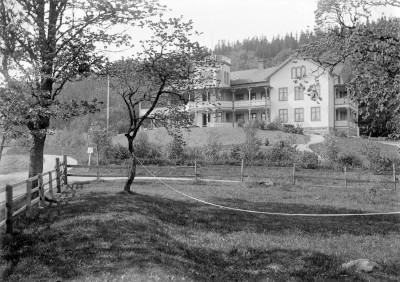
13. Ombergs Touristhotel
After the opening of the Vadstena-Ödeshög railway line in 1888, Omberg and its historic surroundings became an
easily accessible destination. There was a demand for food and accommodation for travellers and in 1893 the
tourist hotel was opened. Vadstena-Omberg. The picture above shows the facility as it looked at the turn of the
century with an extension from 1897 in the east. It was the Omberg-Vadstena Tourist Association that initially
ran the hotel.
In January 1912 the hotel burned down, but was rebuilt and ready for opening in May 1914. This is how we know it today.
 Alvastra monastery ruin. [from Ödeshögs hembygdsbok]
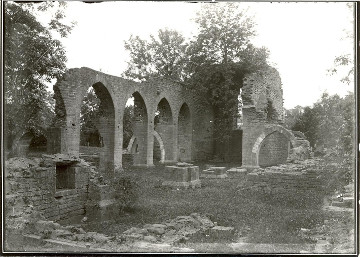
14. Alvastra Monastery ruin
The monastery of Alvastra was founded in 1143 by French Cistercian monks. The Holy Birgitta received her most
important revelations here. During and as a result of the Reformation in the 16th century, the monastery was
dissolved after King Gustav Vasa had confiscated the properties of the church. The stones of the buildings were
taken away and reused for the construction of the castle in Vadstena and Per Brahe's buildings at Lake Vättern.
The Alvastra monastery became a ruin.
15. Pile dwellings
The pile dwellings of Alvastra are Sweden's only pile dwellings of the late Stone Age and one of the oldest
prehistoric sites dating back to about 3100 years before Christ's birth. The pile dwellings are interpreted
as a central place of ritual importance and with a relatively short useful life. Nowadays there is not much
to see above the earth, but there are signs describing the complex.
16. Södra Djurledet
Here at Södra Djurledet was one of the five gates that allowed access to the state enclosure.
 Pentecostal excursion to the Hjässatorget. [From Ödeshögs hembygdsbok]
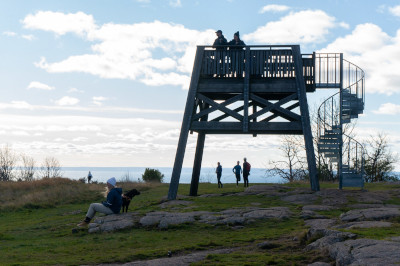 Observation tower on Hjässan. Photo: Jim Löfgren
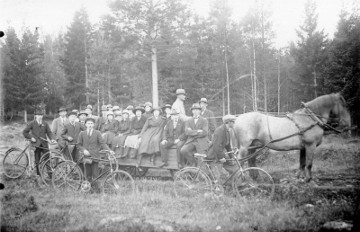
17. Hjässan and Hjässaborgen
The Hjässan, the highest point of the Omberg with a height of 263 metres, is one of the most popular excursion
destinations on the Omberg. It offers an excellent view over Vättern, Tåkern and the Östergötland plain. On the
mountain there are remains of the Hjässaborg, the largest of Omberg's three hill forts with a massive
450-metre-long stone wall, which originally could have been several metres high.
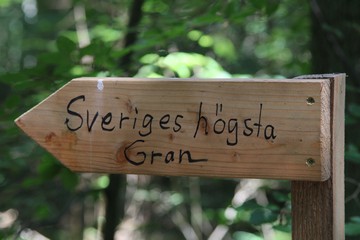 On the way to Sweden's tallest fir tree
18. Sweden's tallest tree
Sweden's tallest tree is a silver fir. It is 49.5 m high (measured in 2016) and has a circumference of 3.30 m
at the foot. The fir tree was planted by Omberg's Skogsskola (1859-1935) only a stone's throw away from the school.
19. Former forestry school
Former forestry school on the Omberg (1859-1934). The forestry school was founded in 1859 by the Swedish Forestry
Commission to train forest guards on behalf of the state. The training lasted one year. The school was closed in
1934. During the existence of the forestry school, numerous experimental plantings of imported tree species were
made on the Omberg.
20. Höje Lilläng
The best meadow flora of the Omberg can be found on Höje Lilläng. Together with the provincial government of
Östergötland, Sveaskog restores the former meadows by traditional mowing and grazing.
21. Mörkahålkärret's nature reserve
Mörkahålkärret's nature reserve consists of a lime moor with several different kinds of orchids, such as fly
orchids and marsh orchids, as well as many other plants that like calcareous soil.
22. Oxbåset
The steep slope, which is well worth seeing, drops down almost vertically in the Vättern. Along a deep gorge
it is possible to descend to the lake. Limescale deposits create a mosaic-like pattern in the slope.
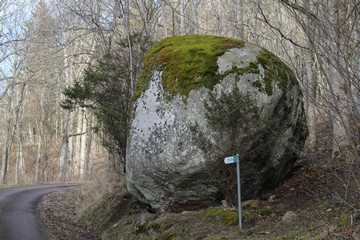 Per's stone
23. Per's stone
The giant Per from Tiveden has left his trail (s) here in the form of a boulder, Pers Sten, at a curve of the
Lake Road. Per threw the stone across the Vättern in order to destroy the church bells in Heda, whose ringing
bells bothered him.
24. Norra Sjövägen (Northern Lake Road)
The Norra Sjövägen begins in Stocklycke and runs as a one way road to Borghamn. From it you can enjoy
overwhelming views.
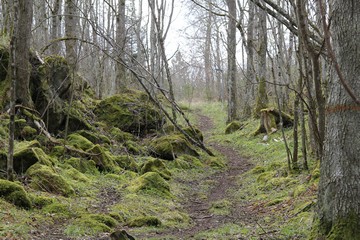 Trail at Borggården
25. Borggården
The best-preserved of Omberg's three hill forts is located in a secluded location about two kilometres north
of the Hjässatorget. The fort itself is relatively small and lies on a ledge facing east.
There is no scheduled service to Omberg. But at Östgötatrafiken you can book journeys between Vadstena and northern Omberg as well as between Ödeshög and southern Omberg. Read more on Östgötatrafiken - Närtrafik (In swedish only, use translation function of zour browser for information in English).
26. Älvarums udde
Älvarums udde is a bold place at the Vättern with a barbecue site, wind shelter and swimming and fishing opportunities.
27. Storpissan's nature reserve
The Storpissan Nature Reserve is a forest rich in fir trees with many old trees. The forest has many deadwoods
and stumps in different stages of decay, attracting a number of insects, lichens and birds. In spring,
Storpissan's outflow in the Vättern forms a powerful stream.
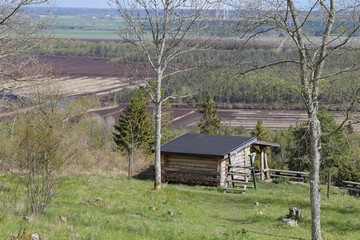 View from Makersbergen on Dags Mosse
28. Dags Mosse
The extensive moor between Tåkern and Omberg was originally a bay of Lake Tåkern. Peat is extracted here in an
ecological way. The moor is drained to the south through the Ålbäcken, which flows into the Vättern.
29. Makersbergen
Makersbergen has a nice view of Dags Mosse, Tåkern and the plains. Shelter with fireplace outside the pasture.
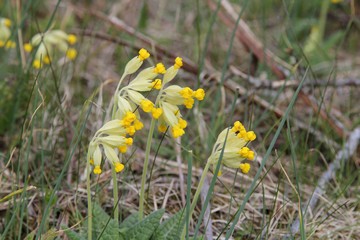 Renstadsfällan
30. Renstadsfällan
Renstadsfällan is a flowery natural pasture landscape where primroses bloom in summer.
31. Ragels kärr
Ragels kärr (bog) is the headwaters of the Storpissan brook, which flows into the Vättern in Älvarum Bay.
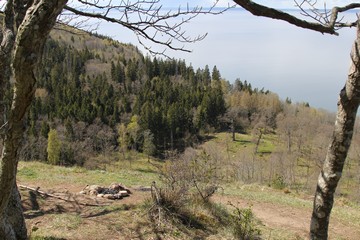 View from Marbergen
32. Marbergen
Marbergen offers a beautiful view over the surroundings, for example the nature reserve of Storpissan.
33. Omberg's giant oaks
The giant oaks on the Omberg are in an area of sixteen hectares. About forty trees are several hundred years old.
By keeping the area open and with the help of grazing animals, Sveaskog restores the pasture landscape that
existed 150 years ago. There are numerous unusual insects living in trees, including the rare hermit beetle.
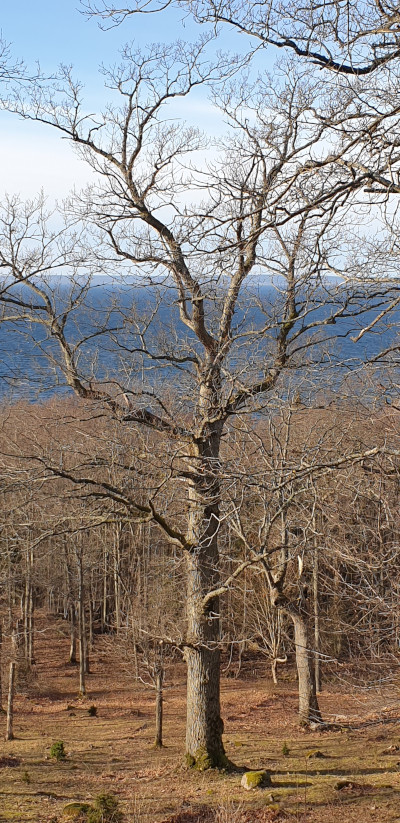 Ombergs äldsta ek
34. Omberg's oldest oak
Below Sjövägen you can see an oak tree, which began to grow in 1374. It was the same year as Hl. Birgitta's
remains were sent back to Vadstena from Rome (she had died in Rome the year before).
35. Hälle källor (Springs of Hälle)">Hälle källor (Springs of Hälle)
The Hälle springs on the Omberg were probably already used as a ritual site in pre-Christian times and experienced
a documented heyday in the 19th century. Nowadays, they are mainly used as a watering hole for thirsty hikers.
Above the springs is a little-known wind shelter with a barbecue place and a view.
38. Vitlerbäcken
The Vitlerbäcken is a lime-rich brook, where a lichen inventory was carried out.
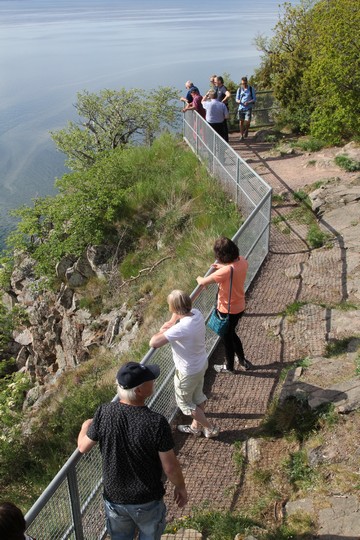 Västra väggar
37. Västra Väggar
Västra Väggar offers a fantastic view over the Vättern.
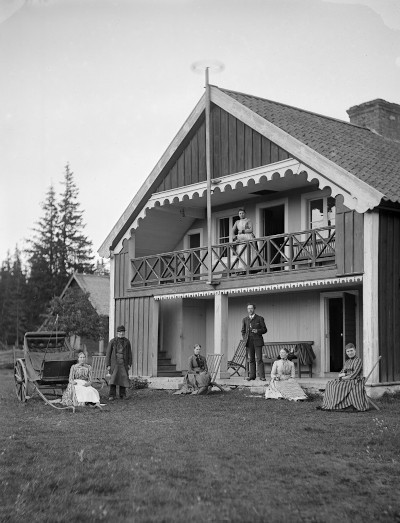 Forest lease farm, 1889 - Photo: Carl Curman (RAÄ)
NN. Svartsvall
Waldbauernhof (237 m ü. d. M.) aus den 1850er Jahren. Gehörte zu Hovgården und wurde 1867 an den Staat verkauft.
Liegt im Zentrum des nördlichen Ombergs zwischen Ombergsliden und Västra väggar.
38. Hålmossen's nature reserve
On the eastern slope of Omberg there is a pearl of calcareous bogs and calcareous wetlands with a very rich flora
and snail fauna. Here, moving groundwater gushes forth in springs. A couple of these bogs are part of the
Hålmossen nature reserve.
Borghamn Strand
Open for overnight stays from spring to autumn. Café and restaurant open 11-17 every day in summer, weekends in
autumn and spring. +46-143-10 999.
Gyllenhammars Restaurant
An experience for all the senses. Open from Easter to autumn. Daily except Tuesdays in summer, weekends
(Fridays, Saturdays) in spring and autumn. +46-143-200 02.
Kafé på Skedet
Kafé på Skedet is a popular summer café, famous for its pastries and bread, pub afternoons, so called "middagsklubben",
music entertainment and art exhibitions. Café open thursday-sunday 11-17, pub friday 17-22.
¨46-73-702 2097.
Ombergs Touristhotel
Hotel and Restaurant. Open all year round.
+46-144-330 02.
Stocklycke Youth Hostel and Café
In the centre of the Omberg ecopark with hiking trails on the doorstep. Open for overnight stays all year round.
The café is open weekends in spring and autumn, daily in summer.
+46-76-145 04 08
Ödeshögs Youth Hostel
Open 1 May - 15 September. Book via
+46-144-107 00,
or Youth Hostel Mother Eva Gustafsson +46-72-544 7166.
39. Ostmossen's nature reserve
The nature reserve consists of a mosaic of different nature forms such as lime moor, wet meadows, dry limestone
meadows, open pastures as well as deciduous and coniferous forests, often with a marshy character. The flora is
rich. About ten species of orchids can be found, as well as a lot of other plants that require a calcareous
environment. In addition, Ostmossen with the nearby Ombergsliden forms one of Sweden's most distinguished places
of residence for large butterflies. Almost 300 different species were counted here. That is one third of all
butterfly species in Sweden.
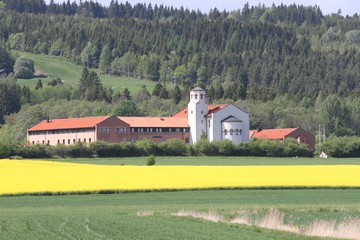 Hl. Hjärtas Kloster (Convent of the Sacred Heart)
40. Hl. Hjärtas Kloster (Convent of the Sacred Heart)
The Convent of the Sacred Heart is located on a beautiful natural slope on the Omberg hill, which was inaugurated
in 1997. Here the sisters live a monastic life according to the rules of St. Benedict with the Virgin Mary as mother
and example.
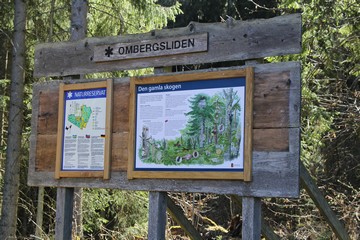 Ombergsliden
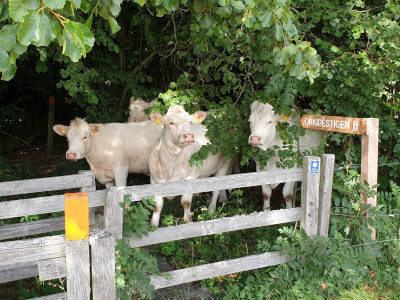 Orchid trail. Photo: Bernd Beckmann
41. Ombergsliden's nature reserve
Ombergsliden is mainly known for its rich orchids. Here one encounters species such as fly orchid, spotted orchid,
broad-leaved helleborine, marsh helleborine, listera ovata, early marsh-orchid and the rarely encountered gymnadenia
odoratissima. In the bogs of the nature reserve, which are rich in minerals, unusual snails such as the vertigo
geyeri can be found.
42. Ombergsliden's ski slope / Mountain Lodge
Ombergsliden is a ski area on the east side of the Omberg. It offers two pistes, two lifts, a toboggan run,
Big Jump and the Mountain Lodge winter café.
43. Vallgatan
The Vallgatan runs east of Sjövägen from Drottning Ommas Borg to Höje. It is closed to general traffic.
44. Anudden
Anudden is a small headland with a very beautiful beach made of cobble stones.
45. Marsastenen
The Marsasten is a boulder which, according to legend, was rolled to its exposed location on Marsafällan by the
giant Mars. Not far from here, directly above Marsabäcken's waterfall and on Omberg's north-eastern fault edge,
there is an old lookout point.
The blue and yellow marked Marsafällan trail once led here from Steneborg and Vallgatan. It is now difficult to recognise in the terrain. However, a new path marked by a private initiative misses important parts of the old route.
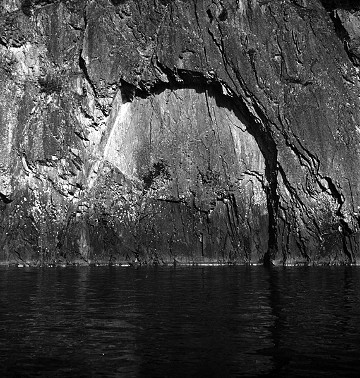
Rödgavel's most dangerous rival was a giant from Västergötland called Ringabergsbusen. Once he came riding across the ice of Lake Vättern to court Omma, who was waiting on the mountain. As he spurred his horse to take the leap up the Rödgavel slope, the horse struck its hoof on the rock face. Both horse and rider fell back onto the ice, which broke and both drowned. Since then, Queen Omma sits on the mountain and cries. Her tears run down into Rödgavel's cave, which is why it always drips from the roof there. Where the giant's horse hit the rock wall, a ten metre wide mark appeared, which is now known as the Rödgavel's gate.
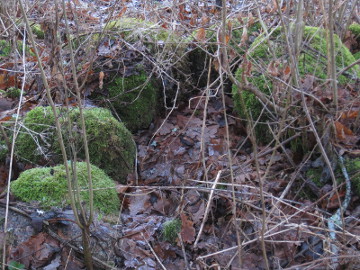 Traces of the state enclosure
46. Brottsledet
Here at the quarry and the old road to the Omberg, the north-eastmost opening was in the fence of the royal
enclosure. The gatekeepers' houses were not demolished until 1946.
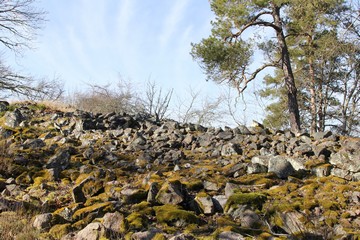 Drottning Ommas Borg
47. Drottning Ommas Borg
Drottning Ommas Borg is the northernmost and smallest of the three hill forts on the Omberg from the migration
period of 450-550 AD. Thanks to the steep slope to Vättern, the castle was impenetrable from the west. A double
wall with palisades provided protection on the east and northeast side. There are many legends surrounding the
castle. Verner von Heidenstam (1849-1940) wrote the poems "Bygdeborgen" and "Borgen susar", which deal with
Queen Omma.
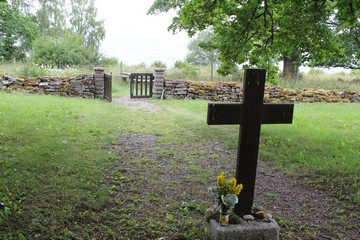 Bockakyrkogården.
48. Bockakyrkogården
The small cemetery is idyllically situated in the middle of a grove of mighty oaks and hazel bushes under the
northern slopes of Omberg. The small hills conceal about 80 graves of men from the Crown Labour Corps, i.e.
prisoners who worked in Borghamns limestone quarry . They quarried stone for the fortress of Karlsborg on the
western shore of the Vättern. A simple wooden cross has been erected at the site: "Here, between 1860 and 1894,
around 80 men from the Crown Labour Corps were buried. They quarried stone for the Karlsborg fortress."
("Här begravdes 1860 - 1894 omkring 80 man ur kronoarbetskåren. De bröto stenen till Karlsborgs fästning.")
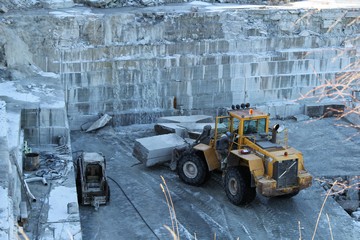 Limestone quarrying in Borghamn
49. Borghamn's limestone quarry
Limestone has been used in Sweden as building material since the beginning of the 12th century. Here in Borghamn, the Cistercian
monks began to break limestone for their monastery in Alvastra, which was consecrated in 1143. Since then,
the quarry has been used continuously to this day. Other important buildings using limestone from Borghamn
were the monastery church in Vadstena, the Götakanal, Karlsborg Fortress and the National Museum.
50. Laundry (former fishing museum)
Borgham's fishing museum was housed in the former laundry of the Royal labour corps for more than three decades.
Equipment and fishing methods from Borghamn's history were on display here. The museum itself is now history.
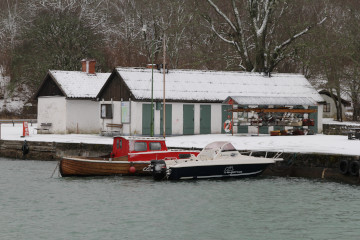 Borghamn's harbour
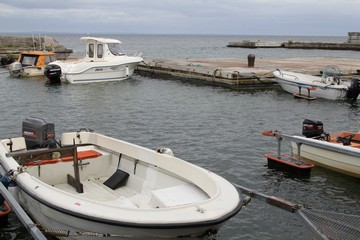 Borghamn's harbour
51. Borghamn's harbour
The western part of the harbour in Borghamn was built between 1813 and 1827 by the Göta Canal Company to cope with
deliveries to the construction sites on the Göta Canal between Motala and the Baltic Sea. In the second half of the
19th century, the eastern part was added with the so-called Bondbryggan for the transport of grain to Western Götaland.
 Borghamn Strand
 Borghamn Strand
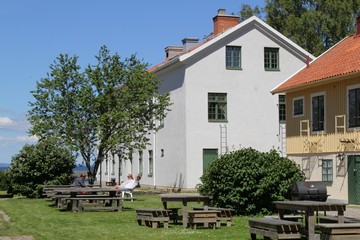
52. Borghamn Strand
Borghamn Strand was opened in April 2019 in the old premises of the former Borghamn School and is a popular
destination for hikers and day visitors in Borghamn and on Omberg. Here you will find accomodation with hotel and
hostel standard, a harbour café, sauna and kayak rental.
The facility was a work station under the direction of the Crown Labour Corps, after the swedish state bought the quarry and harbour in 1842.
The entire area has been declared a listed building since 1993 (Borghamn School) and registered as a working life museum since 2023. Read more on Borghamn's listed buildings.
53. Borghamnsten AB
Borghamnsten is a natural stone processing company in the tradition of the historic limestone quarry at the northern
end of Omberg. The company processes limestone from Borghamn and marble from its own quarries in Brännlyckan (near
Zinkgruvan) and Ekeberg (near Glanshammar).
 Kafé på Skedet
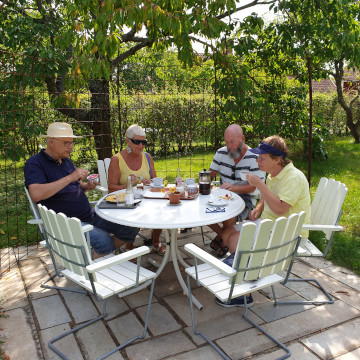
54. Kafé på Skedet
Kafé på Skedet is a popular summer café, famous for its pastries and bread, pub afternoons, so called "middagsklubben",
music entertainment and art exhibitions. Café open thursday-sunday 11-17, pub friday 17-22.
¨46-73-702 2097.
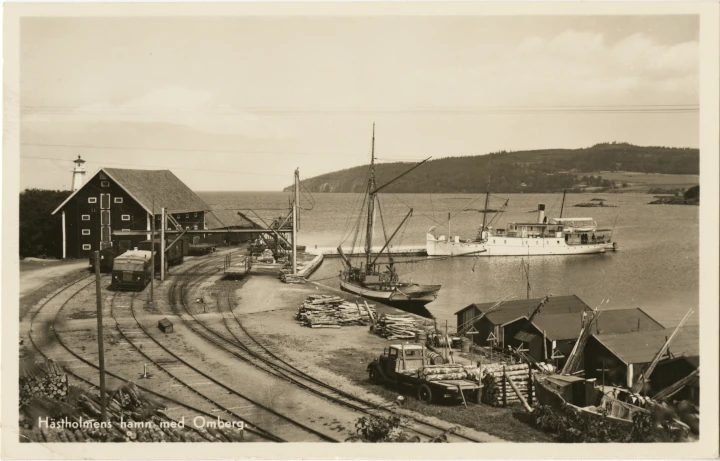
A greeting from Omberg. Hästholmens harbour with Omberg in the background.
The postcard from the Swedish Railway Museum's collection shows Hästholmen harbour with Omberg in the background.
Hästholmen was an important trading centre and had town privileges already in the early Middle Ages. The shortest route from Östergötland to Västra Götaland was via Lake Vättern, which is why Hästholmen harbour retained its importance for a long time.
At the pier is the steamship SS Trafik, which then, as now, travelled on Lake Vättern and the Hjo-Hästholmen route. Today, Trafik is a museum ship. But it comes to visit Hästholmen every year.
In the foreground are the tracks of two railways.
The narrow-gauge Fogelsta-Vadstena-Ödeshög Railway opened its service to Hästholmen and Ödeshög in 1888. The railway was closed in 1958.
The standard gauge railway, whose railcar we see on the left, was the Mjölby-Hästholmen Railway, which was inaugurated as late as 1910. Passenger traffic on the entire route was closed in 1958, freight traffic in stages in 1980 (harbour track), 1983 (Väderstad-Hästholmen) and 1990 (Mjölby-Väderstad).