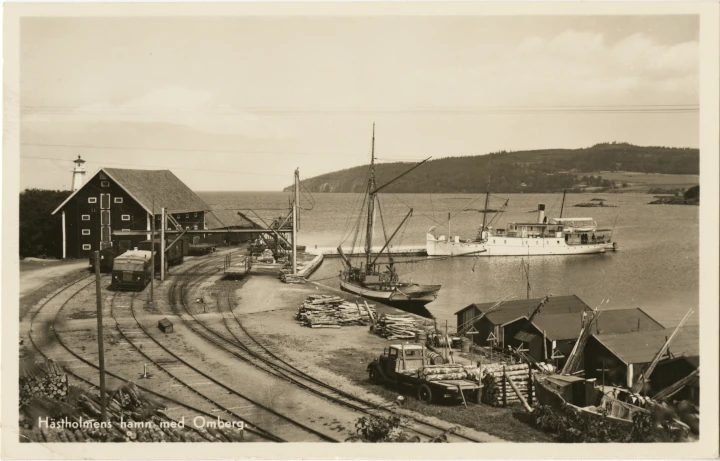
A greeting from Omberg. Hästholmens harbour with Omberg in the background.
The postcard from the Swedish Railway Museum's collection shows Hästholmen harbour with Omberg in the background.
Hästholmen was an important trading centre and had town privileges already in the early Middle Ages. The shortest route from Östergötland to Västra Götaland was via Lake Vättern, which is why Hästholmen harbour retained its importance for a long time.
At the pier is the steamship SS Trafik, which then, as now, travelled on Lake Vättern and the Hjo-Hästholmen route. Today, Trafik is a museum ship. But it comes to visit Hästholmen every year.
In the foreground are the tracks of two railways.
The narrow-gauge Fogelsta-Vadstena-Ödeshög Railway opened its service to Hästholmen and Ödeshög in 1888. The railway was closed in 1958.
The standard gauge railway, whose railcar we see on the left, was the Mjölby-Hästholmen Railway, which was inaugurated as late as 1910. Passenger traffic on the entire route was closed in 1958, freight traffic in stages in 1980 (harbour track), 1983 (Väderstad-Hästholmen) and 1990 (Mjölby-Väderstad).
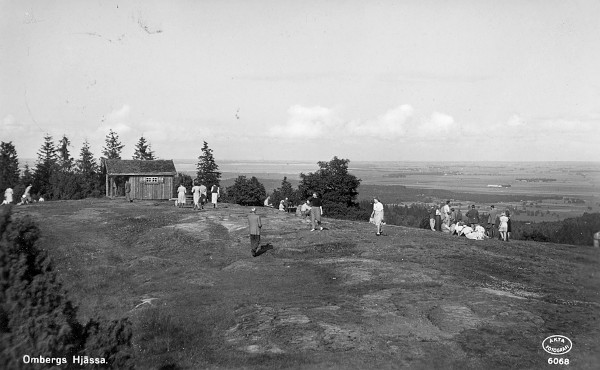
A greeting from Omberg. Ombergs Hjässa, before 1950.
An excursion to Ombergs Hjässa was popular then as now.
The picture was in the archive of Josef Lindberg (1891-1964) and Gunhild Maria Lindberg born Axbom (1893-1979), which was donated to Östergötland Museum in 2004 by a relative, Roy Andersson.
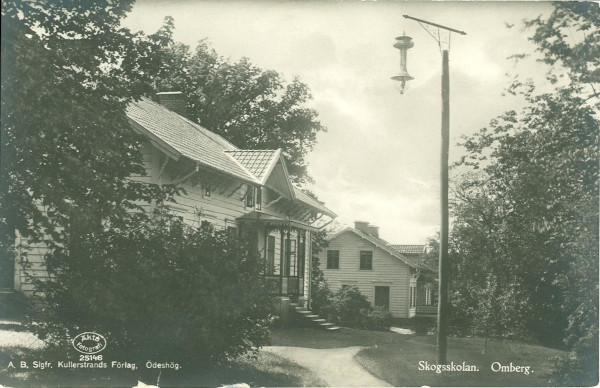
A greeting from Omberg: Ombergs forestry school, (from Ödeshögs hembygdsbok)
Former forestry school on the Omberg (1859-1934). The forestry school was founded in 1859 to train foresters on behalf of the state. The training lasted one year. The school was closed in 1934. During the time of the forestry school, among other things, numerous experimental plantings of imported tree species such as silver fir and larch were made in order to expand the students' knowledge of foreign tree species. You can experience the many tree species from the forest school days along the forest trail Skogsslingan (Forest loop, Trees and bushes), which starts at Hjässatorget. The school buildings are now privately owned.
Source: Skogsencyklopedin, published by Sveriges Skogsvårdsförbund (now Föreningen Skogen), Stockholm 2000, and Sveaskog.
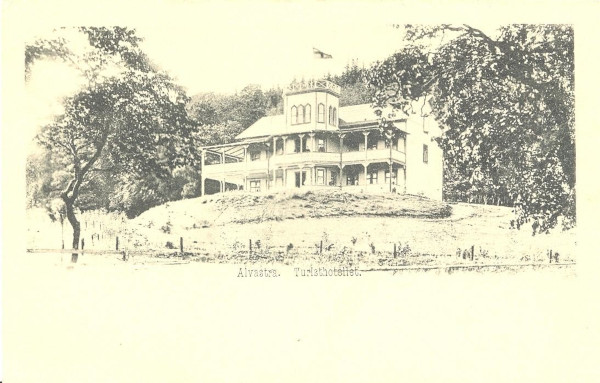
A greeting from Omberg: Touristhotel in Alvastra (1892-1897), (Collection Ödeshögs hembygdsbok)
The narrow-gauge railway between Vadstena and Ödeshög was opened in 1888. This was the beginning of tourism on the Omberg: in 1892 Omberg's Turisthotell in Alvastra was opened, in 1914 Gyllenhammars Pensionat in Borghamn and in 1934 the Youth hostel in Stocklycke.
Thanks to the railway connection it had become easy for the inhabitants of nearby cities to reach the Omberg.
The photo shows the original building, which was erected in 1892-93 by local residents. The visitors spent their time here, among other things, with walks in nature and rowing boat trips on the Vättern. In order not to get lost, they were accompanied by young guides who were familiar with the area. Behind Omberg's tourist hotel one can still come across stairs that had been built for the purpose of making it easier for hotel guests to access nature.
In 1897 the hotel was extended. It was expected that there would be a larger number of travellers and guests in this beautiful area than before, because the Linköping-Fogelstadbahn was opened. In the beginning the hotel was run by the Swedish Tourists Society.
The current tourist hotel dates back to 1914, after the old hotel was destroyed by fire in 1912. Learn more about Ombergs Turisthotell.